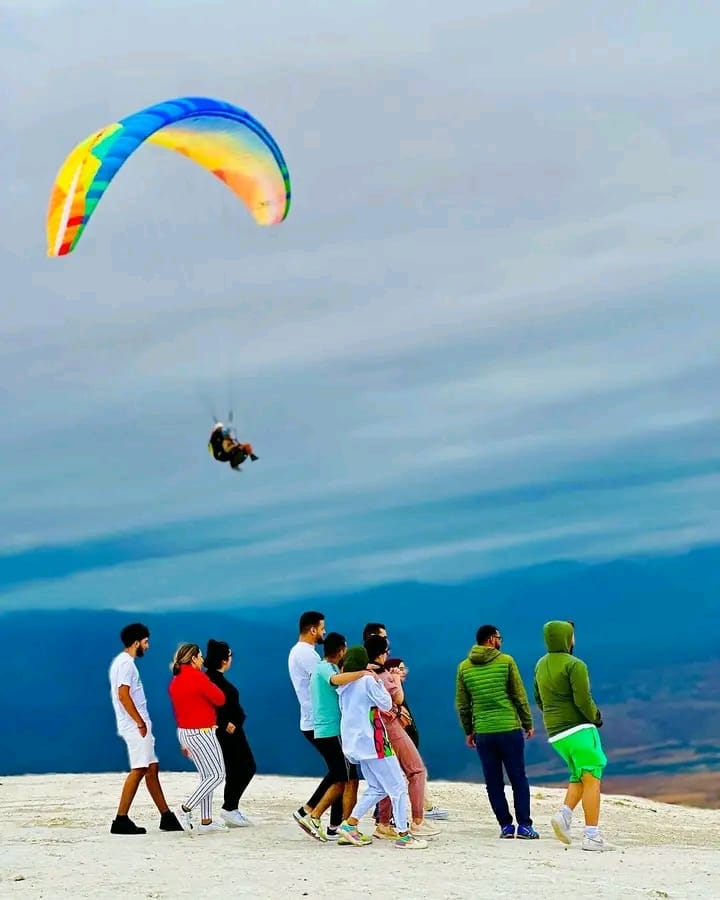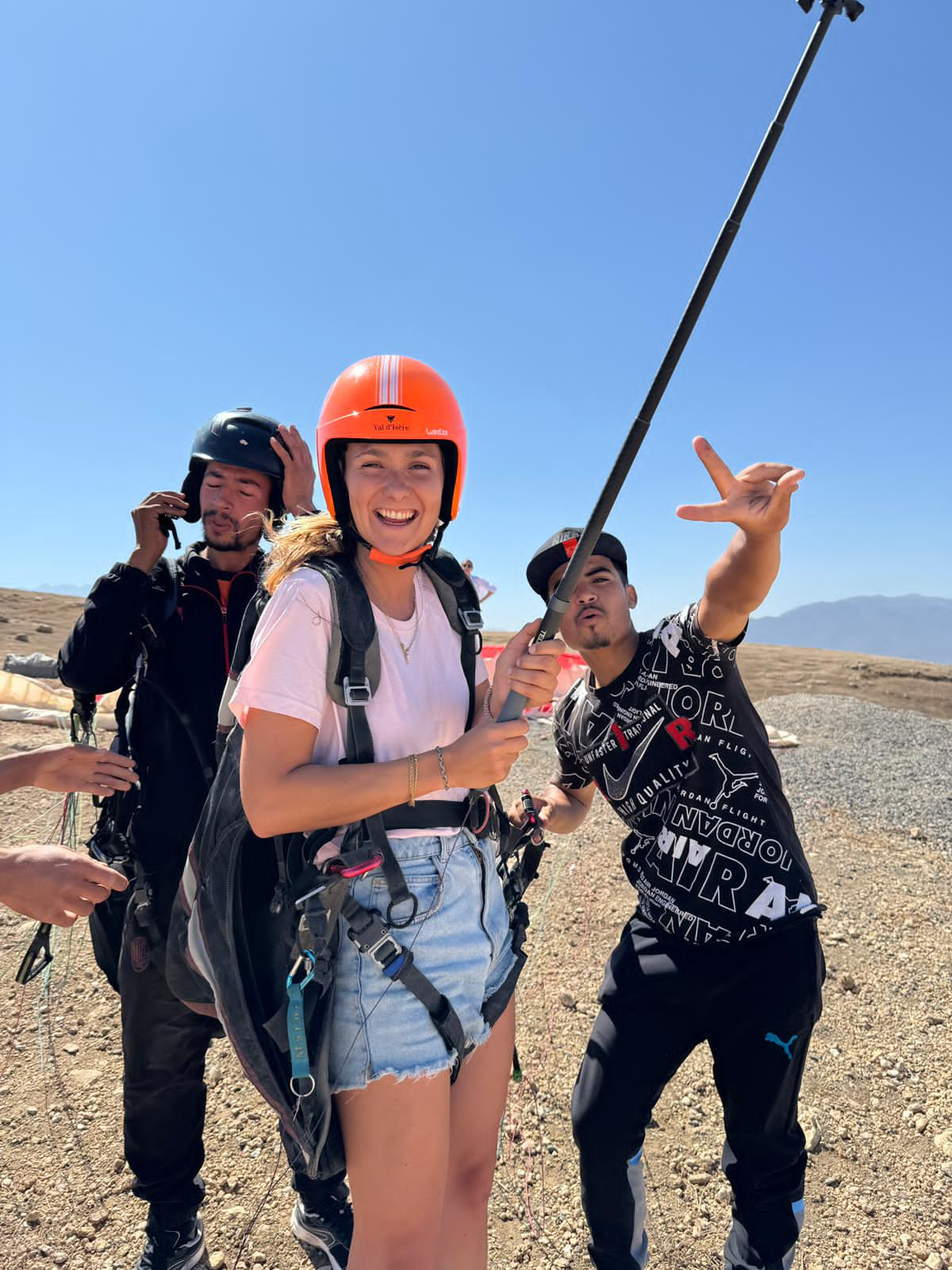

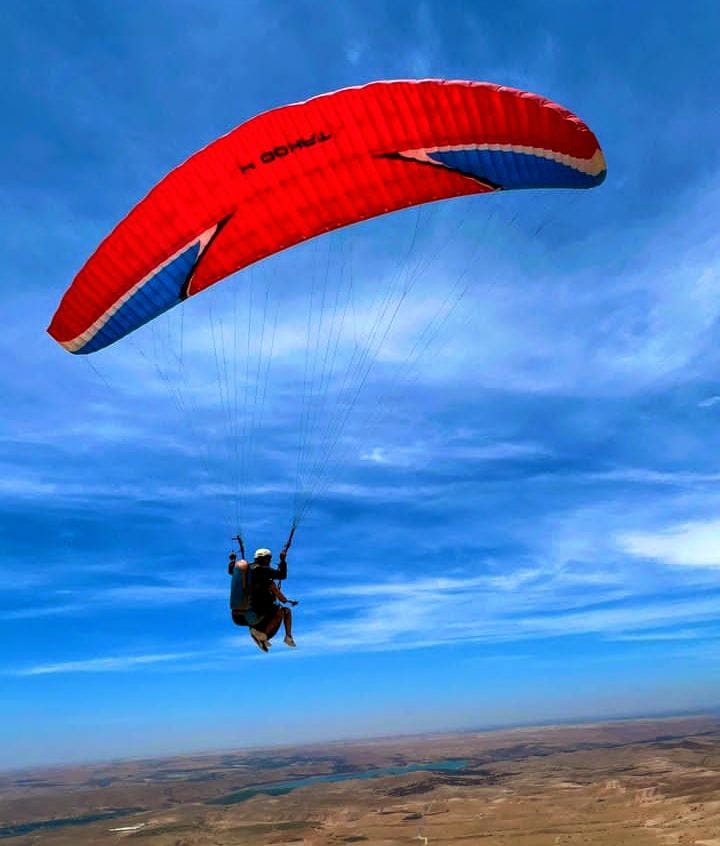
People looking for skydiving in Morocco or around Marrakech often land on paragliding pages, and the two get mixed up all the time. Both use a fabric canopy, and for the passenger they could hardly be more different. Here is what your body notices during a tandem paragliding flight, and how that differs from a jump. To be clear from the start, Sky Paragliding, near Marrakech, offers tandem paragliding only. We do not run skydives.
Paragliding vs skydiving: it comes down to how you start
A sport jump begins with leaving an aircraft. You then fall until the parachute opens, and a skydiver in a stable belly-to-earth position reaches about 200 km/h. That fall, and that speed, are what people come for.
A paraglider starts from the ground, on foot, on a slope. The wing is already inflated above you before your feet leave the hillside, so it is carrying you as the ground falls away. There is no moment of falling at all. In a skydive the parachute is the tool that brings you safely back to earth after freefall, whereas a paraglider is built to stay in the air and to climb on rising air.
| Tandem paragliding | Skydiving | |
|---|---|---|
| Start | On foot, on a slope | From an aircraft |
| Freefall | None | Yes, before opening |
| Main sensation | Calm, quiet, scenery | Speed, rushing air |
| Position | Seated in a harness | Belly-down, then hanging |
The first ten seconds: noise and a tug
The pilot raises the wing behind you. It fills, it pulls at your shoulders, and from then on it is holding you. You walk three or four steps because the ground slopes away, and then it is no longer there. Nobody jumped.
These first seconds are the loudest of the flight. The fabric snaps, the lines whistle, you can hear the pilot breathing. You will want to look at your feet. Look ahead instead: it is the one instruction that really counts at that moment. If this is your very first time, our page on a first paragliding flight in Marrakech takes these moments in turn, along with the most common worries.
The moment you sit down
The pilot pulls a strap and you tip back into a seated position. You are not dangling from a climbing harness. You are in a padded seat with a backrest, much like a deckchair. The noise cuts out all at once, and that silence is what passengers talk about on the way down, more than the view. Your hands can let go of the risers and the conversation starts. The pilot sits thirty centimetres behind your head, so you talk normally, without shouting.
Do you feel the speed? Does your stomach drop?
In a glide you do not feel the speed, because the ground is too far away to act as a reference. What you notice instead is how slow it all seems, and fifteen minutes in the air feel like four or five.
The rollercoaster stomach drop comes from a sudden fall, and a calm flight does not contain one. Steep turns are another matter: you feel pressed into the seat and you swing out, and some people are sensitive to that. By default the flight stays straight and calm. The pilot only does manoeuvres if you ask and the conditions allow it, and that gets decided by the two of you, in the air, never by surprise. If you start to feel unwell, say so. The pilot flies straight, stops turning and takes the most direct way to the landing field.
Paragliding with a fear of heights
Fear of heights needs a fixed reference close by: the edge of a balcony, a ladder, a wall dropping away. In flight there is no such reference, and the feeling nearly always goes in the first minute. The nerves tend to come earlier, before take-off, while the harness is tightened, the wing is laid out and you look down the slope. We cannot promise you will not be scared. We can tell you where the fear usually sits, and that nothing obliges you to go once you are at the top.
Cold air and the landing
The air in flight is noticeably cooler than at take-off, even in summer. A light jacket makes all the difference, especially for your hands.
On approach the pilot gives the word, you bring your legs forward and the field comes up more slowly than you expect. You land at a walk. Our page on tandem flights near Marrakech describes this and everything before it, and the whole outing, road included, is laid out in our step-by-step account of a flying morning.
What you do not have to do, and what to keep in mind
The passenger has nothing to do and no controls to hold. Nothing you do from the front seat affects the flight path, and many people find that reassuring. It does not change what this is: paragliding remains an air sport that depends on the wind and on the pilot’s judgement, and no amount of supervision removes every risk. Tell us about any heart condition, weak back, pregnancy or recent operation so we can decide together before you go up.
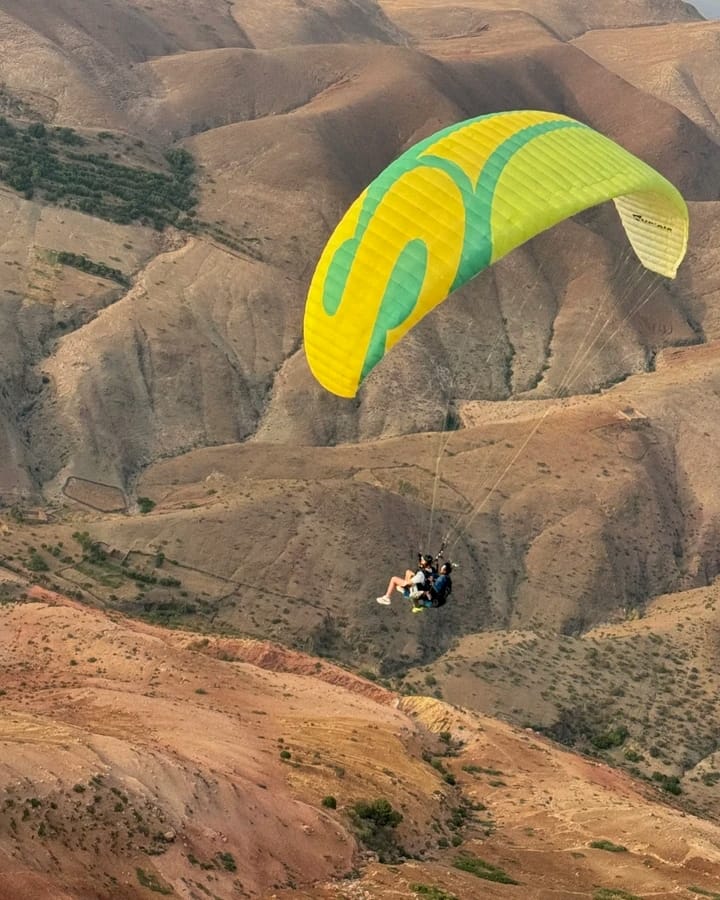
Once you are settled in the seat, your eyes lift quickly. What they find, the lake, the villages and the ridgelines, has an article of its own: the landscape as seen from the wing.