
During a tandem flight you hardly see the person doing all the work. The pilot sits behind you, thirty centimetres from your head. Before going up, most people wonder who this person is and what exactly they do. This article describes the role of the pilot and crew as it plays out at Sky Paragliding in Aguergour, then gives you a few questions to ask, whether you fly with us or anyone else.
Before the flight: reading the day
The work starts well before you arrive. Our pilots have been flying this same slope for over ten years. They know when the breeze picks up at Aguergour, where the air rises best in April, and when it is time to pack up. That knowledge sets your meeting time, which we confirm once the forecast has been read. There is more about the people and the site on our about-us page.
One decision belongs entirely to the pilot: whether to fly. It gets made as the day develops and it is not up for debate, even when the morning looks lovely from below and everyone has made the drive. A postponed flight means the system is working. To see what that call rests on, read our piece on the sky above Aguergour.
At the launch: fitting, explaining, checking
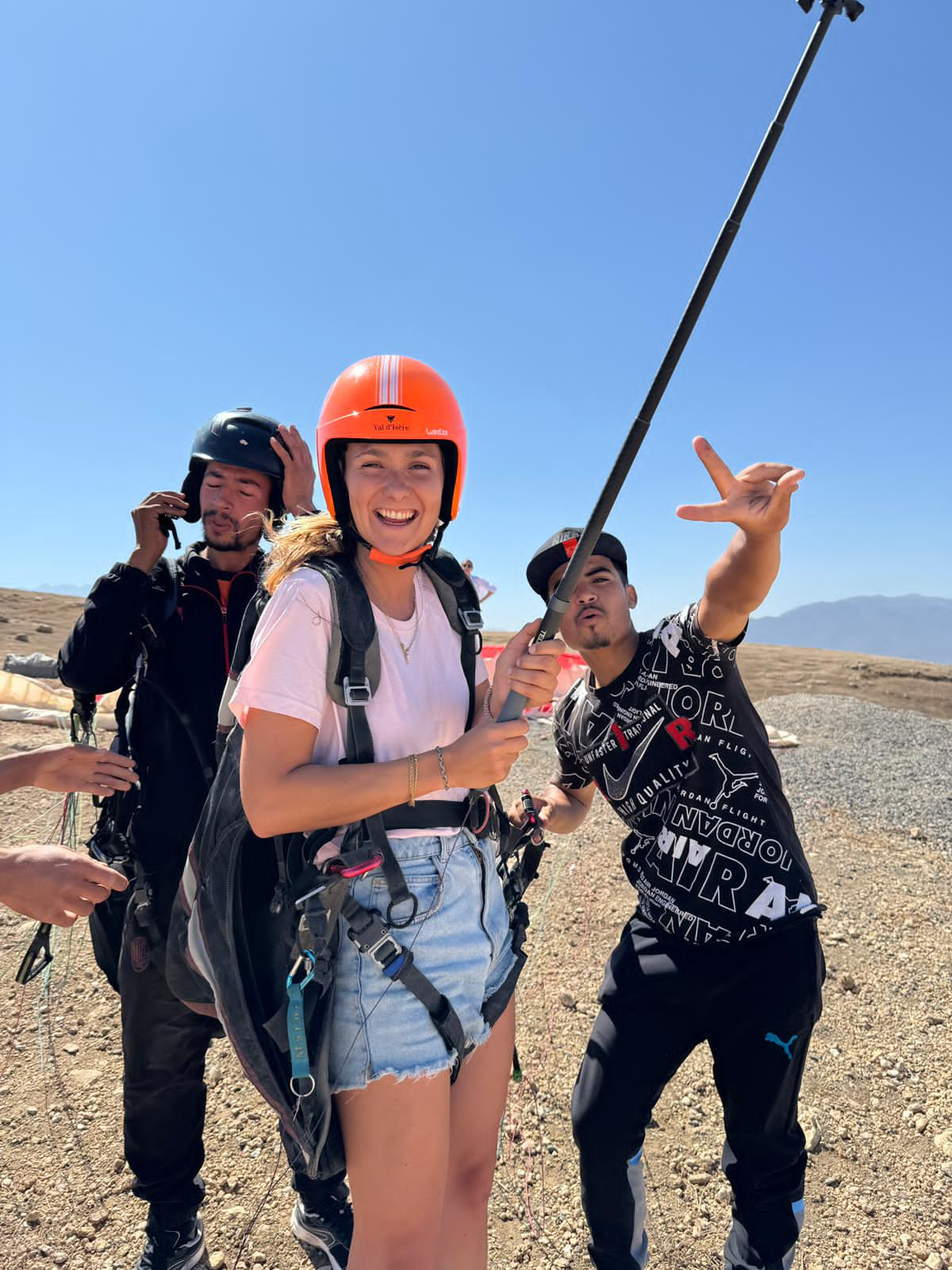
Once you are at the top, the pilot fits you with a harness and helmet in your size. A tandem wing is bigger than a solo one, roughly 40 m² against 25, and gets spread out on the ground. Then comes the briefing in your language: French, English, Spanish, German or Arabic. Nobody takes off without understanding what is about to happen, and the instructions come down to three actions: keep walking, keep your head up, do not sit until the signal.
The last thing before leaving is a check. Four carabiners connect you to the wing, two for you and two for the pilot, locked and checked out loud. Gear is inspected before every take-off, and the reserve parachute on board is sized for the load of the two-seater. Our page on two-seater paragliding and the passenger seat goes through this kit in detail.
In the air: flying, talking, filming
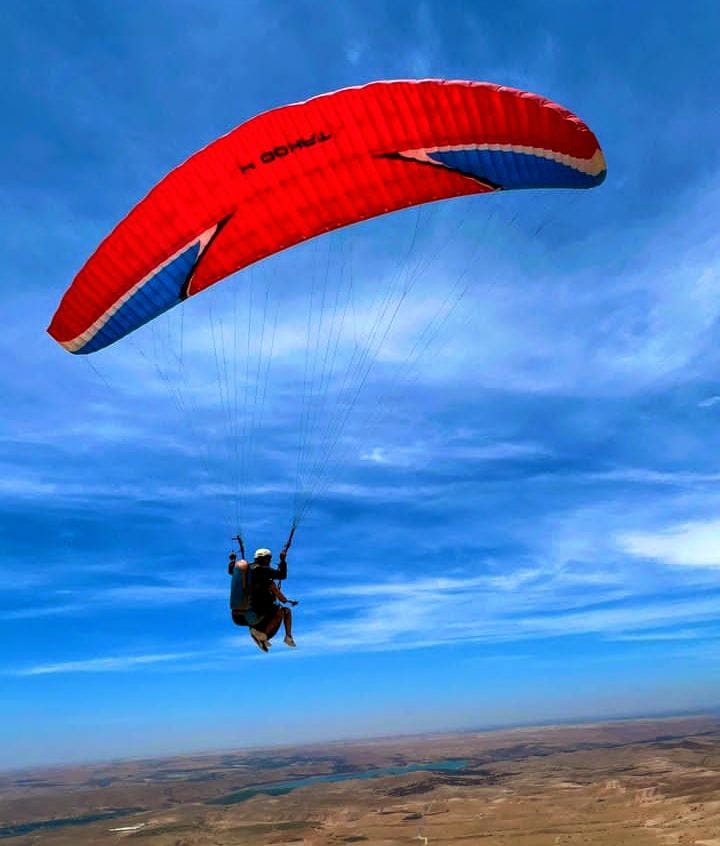
The pilot takes the rear seat because that is where you can see the wing, feel the harness move and keep your hands free. They look for pockets of warm air rising along the slope, and the wing climbs. Meanwhile they talk to you: you chat without shouting, and many passengers save their questions for the air.
If you asked for footage, the pilot films from the wing with a pole. They also adapt the flight to you. By default it stays straight and calm. Steep turns are a joint decision, and if you say you are not feeling good, they cut it short and take the most direct route to the landing field. For how those minutes feel from your seat, see what your body notices during the flight.
Afterwards: packing up and what you take home
On landing, the pilot gives the word, you bring your legs forward and you touch down at a walk. Then comes packing the wing, when the adrenaline fades and people talk freely. Your footage is handed over on a memory card. If the flight made you want to go further, we do not sell lessons, but we know who to send you to in Marrakech.
How does someone become a tandem pilot?
Taking a passenger is not something a pilot simply starts doing after a solo licence. It is a separate qualification, earned after a minimum number of hours and flights and then kept up. The rules vary by country. As one documented example, the Swiss association only admits candidates to the first part of its tandem pilot exam if they have held a paragliding licence for at least two years and can show at least 200 high-altitude flights since getting it. The exam then has a solo part and a tandem part.
That example gives you a sense of the standard expected in this line of work. It does not describe the Moroccan framework, and it says nothing about any individual pilot’s licence, which is something you should ask them directly.
Five questions to ask before you fly
A serious outfit answers these without hesitating. Feel free to ask us as you would ask anyone else.
- What licence does the pilot hold, and is the tandem qualification current?
- How old is the wing?
- What insurance covers the flight? Our tandem flights carry professional liability cover, and you sign a waiver. Check too that your travel insurance does not exclude air sports, as many policies do.
- What happens if the wind rules out flying? With us, we postpone or refund.
- Can I back out at the top? With us, yes: you ride down with the crew and the flight is not charged.
A good crew lowers the risks but cannot remove them, since paragliding depends on the air. To see where each person fits across the whole morning, turn to our walk-through of the trip from Marrakech, or read the tandem flight, plainly explained.